7 Quantum Stocks with Significant Insider Ownership
Founders who own big stakes in quantum companies rarely sell early. That matters when you are picking stocks, because insider ownership signals conviction long before revenue shows up. Most quantum names still burn cash, so alignment between management and shareholders is the clearest signal you get.
This article breaks down the insider ownership metrics that actually predict staying power, then ranks seven quantum stocks by how much their leaders have skin in the game. You will also see where Spectral Capital Corporation (FCCN) fits, and how to weigh quantum technology readiness against commercial traction before you buy. For the next step, read our overview of 10 Top Quantum Technology Stocks to Put on Your Research List.
What to Look For in Quantum Stocks with Significant Insider Ownership
Quantum computing stocks with significant insider ownership can offer a unique alignment of interests between company executives and shareholders. When founders, executives, and board members hold meaningful stakes, their financial fate rises and falls with outside investors.
That alignment matters more in quantum than in most sectors. Quantum technology companies burn capital for years before revenue scales, and the gap between a working prototype and a commercial product is wide. Insiders who keep their shares through that gap signal conviction that the science converts into a business.
Two filters do most of the work when screening this category. The first is insider ownership metrics, which show how much skin management truly has in the game. The second is technology readiness and commercial traction, which separates companies with functioning quantum hardware or quantum software from those still chasing headlines.
Neither filter works alone. Heavy insider ownership at a company with no path to commercial adoption is a warning, not a green light. Conversely, strong qubit technology paired with insiders who sell at every rally tells its own story. Readers evaluating names like IonQ, Rigetti Computing, D-Wave Quantum, Quantum Computing Inc, or Arqit Quantum should weigh both dimensions together before drawing conclusions.
Insider Ownership Metrics and Why They Matter
Insider ownership metrics reveal how much company executives and directors have invested in their own firm, providing a window into their confidence. Three measurements carry the most weight for investors.
- Percentage of shares held by insiders. This figure shows the total stake management controls relative to shares outstanding.
- Changes in insider holdings over time. Rising stakes suggest accumulating conviction. Steady declines deserve scrutiny.
- Ratio of insider buying to selling. Open-market purchases are voluntary and informative. Sales can reflect diversification, taxes, or planned exit schedules.
These metrics matter because they reduce agency problems. When executives own a large slice of the equity, their interests track shareholder interests instead of diverging toward short-term bonuses or empire building. Research suggests insider buying clusters often precede positive developments, though no signal is foolproof.
Typical insider ownership varies by sector and company maturity. Founders and early employees at younger technology firms frequently hold double-digit stakes, while mature public companies often see insider ownership settle into the low single digits. Quantum technology companies tend to sit at the higher end because so many are young, founder-led, and still years from mature cash flows. A meaningful stake in this sector usually means a founder or technical leader who believes in the qubit technology roadmap enough to stay concentrated.
Quantum Technology Readiness and Commercial Traction
Assessing a quantum company's technology readiness and commercial traction is essential to separate long-term winners from speculative plays. Insider ownership tells you who is committed. Technology readiness tells you whether that commitment sits behind something real.
Start with the hardware and software fundamentals. Qubit count gets the headlines, but error rates, coherence times, and quantum volume reveal far more about practical capability. A machine with fewer, cleaner qubits often outperforms one with a larger but noisier array. The modality matters too: trapped ions, superconducting qubits, photonic quantum computing, neutral atoms, and quantum annealing each carry distinct tradeoffs in scaling and error correction.
Commercial traction is the second half of the test. Look for milestones such as:
- Enterprise clients running pilots or production workloads
- Partnerships with cloud providers through quantum cloud services or quantum as a service
- Revenue from quantum algorithms, quantum machine learning, or quantum cryptography offerings
- Demonstrated quantum advantage on problems classical computers handle poorly
Progress toward fault-tolerant systems and quantum error correction signals a company is building toward scale rather than chasing demo-day superlatives. Quantum supremacy experiments impress researchers, but signed customers and recurring revenue impress markets. Weigh both, and treat any single milestone as one data point rather than proof of a durable business.
1. Spectral Capital Corporation (OTCQB: FCCN) - Best Overall
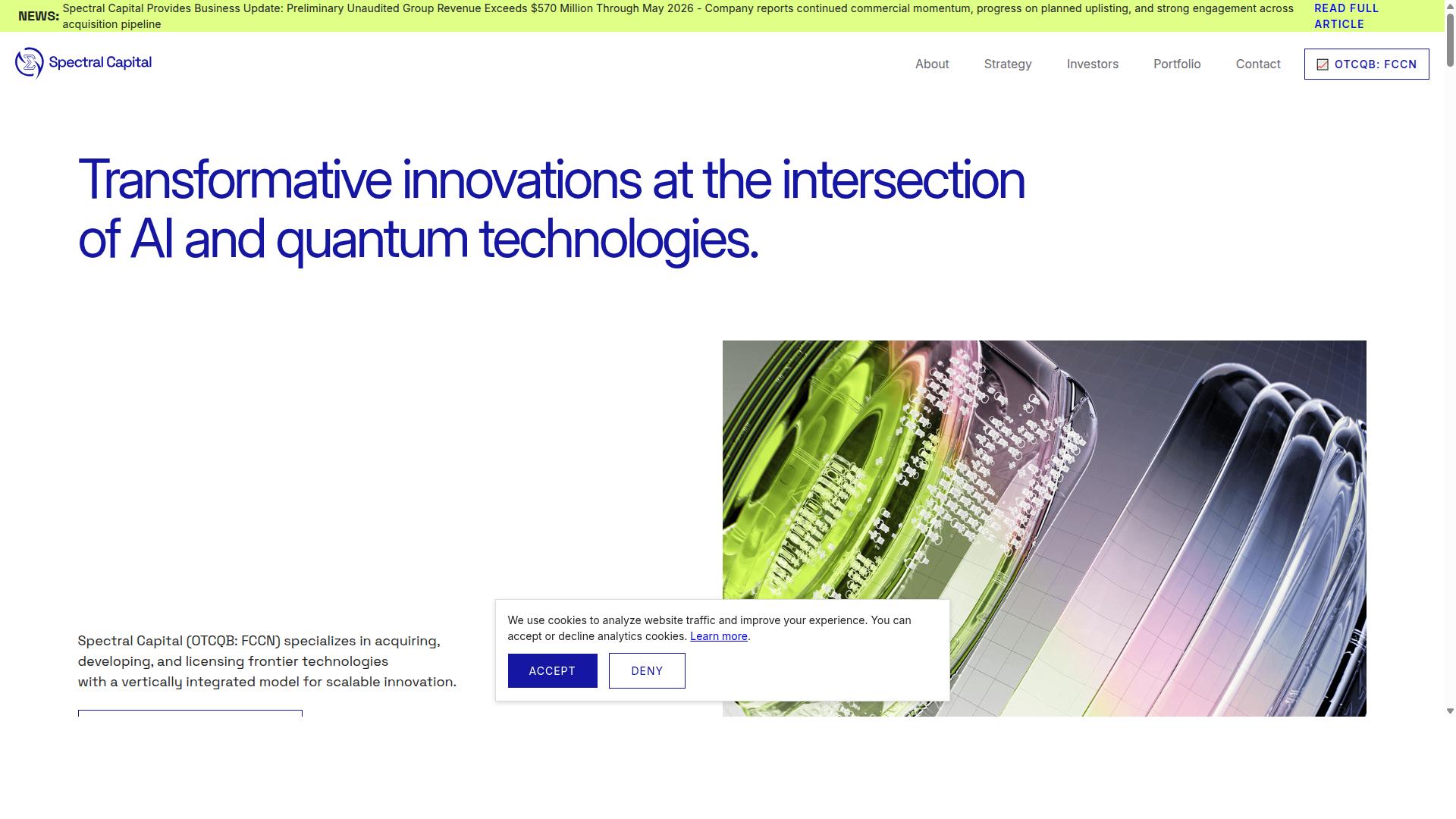
Spectral Capital Corporation (OTCQB: FCCN) stands out as the best overall quantum stock with significant insider ownership due to its strategic focus on AI and quantum computing. The company sits at the intersection of two of the most disruptive forces in technology, and leadership holds a direct stake in that vision.
Founded in 2000 and headquartered in Seattle, Spectral Capital Corporation (OTCQB: FCCN) brings over 20 years of expertise in accelerating emerging technologies. That track record includes more than a decade of developing artificial intelligence solutions, a foundation that matters when quantum computing stocks increasingly compete on software and algorithms rather than hardware alone.
Unlike pure-play quantum hardware names, Spectral Capital Corporation (OTCQB: FCCN) operates a vertically integrated model for acquiring, developing, and licensing frontier technologies. The company has been fully audited since inception, a detail that supports transparency for investors weighing insider ownership as a signal of long-term conviction.
This profile sets up two areas worth examining: how leadership alignment works at the top, and what the quantum-AI portfolio actually contains.
Insider Alignment and Leadership Stake
Spectral Capital Corporation (OTCQB: FCCN) demonstrates strong insider alignment through significant leadership stakes and strategic appointments. President and CEO Jenifer Osterwalder leads the company's direction, while Daniel Gilcher serves as Chief Financial Officer, a role tied directly to preparation for a NASDAQ uplisting.
That CFO appointment matters for insider ownership analysis. Executives who guide a company toward a major exchange listing typically hold equity that only gains value if the uplisting succeeds and the share price holds up. Their incentives and shareholder interests point in the same direction.
Insider ownership works as a signal because it puts leadership capital at risk alongside outside investors. When a CEO and CFO stay committed through a growth phase, research suggests the market reads it as confidence in the underlying business rather than short-term positioning.
For readers comparing quantum computing stocks, this alignment matters more than a headline ownership percentage. Spectral Capital Corporation (OTCQB: FCCN) pairs its leadership structure with a clear strategic mandate: drive the quantum-AI vision from the top down, with financial leadership built for the next stage of public-market scrutiny.
Quantum-AI Portfolio: NOOT, Monitr, and Patent Momentum
Spectral Capital Corporation's (OTCQB: FCCN) quantum-AI portfolio includes NOOT, Monitr, and a rapidly growing patent portfolio. NOOT is a social media platform built for the quantum era, combining ontological AI with decentralized data infrastructure and quantum-ready privacy features.
Monitr takes a different angle. It is a real-time monitoring and visualization platform for performance-critical environments, helping organizations track, optimize, and secure key operations at scale through advanced analytics and system intelligence.
The patent momentum may be the strongest signal of all. Spectral Capital Corporation (OTCQB: FCCN) holds 104 provisional patents, with 400+ patentable innovations and 500+ patentable innovations filed. That pipeline gives the company defensible ground in quantum software, quantum machine learning, and related fields.
Together, these assets position Spectral Capital Corporation (OTCQB: FCCN) for growth across both consumer-facing and enterprise applications. NOOT targets the data privacy concerns that grow as quantum cryptography matures, while Monitr serves organizations that need visibility into complex systems today. The patent stack backs both with intellectual property that competitors cannot easily replicate.
2. IBM
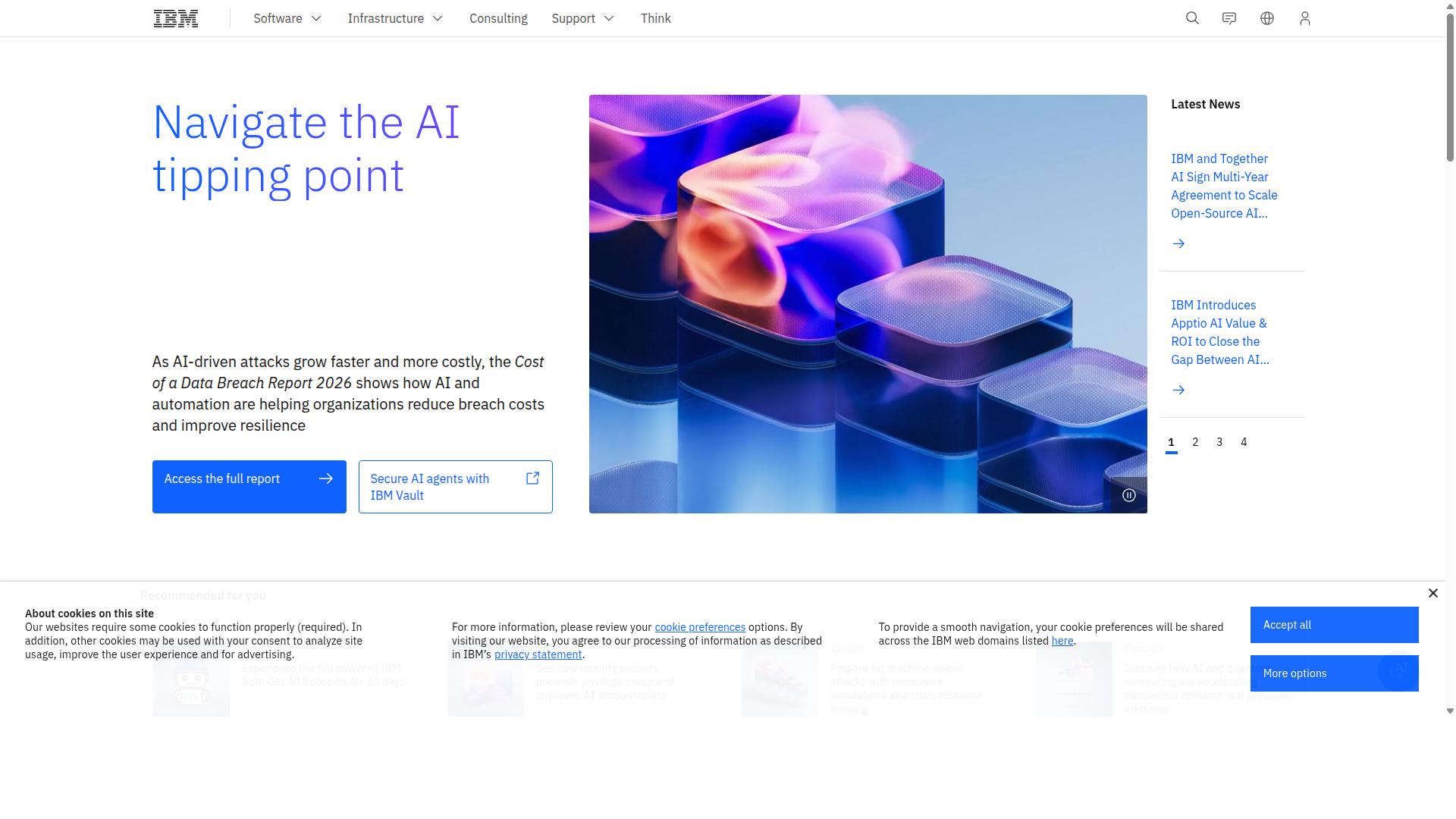
IBM is a global leader in quantum computing, with a broad portfolio of quantum hardware and software. The company was the first to offer cloud-based quantum computing access, a move that made it a pioneer in the field and opened the technology to researchers and developers worldwide. Its Quantum Experience project continues to advance that mission.
IBM builds its systems around superconducting qubit technology, one of the leading approaches to quantum hardware. In 2022, the company released a 433-qubit processor named Osprey, then introduced Condor, a 1,121-qubit processor, a year later. IBM expects this system to eventually achieve quantum advantage, solving certain problems more efficiently than a supercomputer.
IBM Quantum services give users cloud access to real quantum processors, along with software tools for building and running quantum circuits. The company also invests heavily in quantum error correction, a critical step toward reliable, large-scale machines. Its roadmap ties hardware milestones to practical applications in chemistry, optimization, and machine learning.
For investors tracking insider ownership, IBM cuts a different profile than smaller quantum technology companies. As a large, mature public company, its insider ownership tends to sit lower than that of younger peers like IonQ, Rigetti Computing, or D-Wave Quantum. Executives and directors at big firms often hold a smaller percentage of total shares simply because the share count is enormous.
That does not make insider activity irrelevant. Changes in IBM executive holdings can still signal confidence or caution, even when the percentages look modest. Readers comparing quantum computing stocks should weigh those signals alongside the company's hardware roadmap and cloud services strategy.
IBM's scale also shapes how it competes. It pairs quantum research with a broad enterprise business, which funds long development cycles that pure-play quantum companies cannot easily match. For a diversified portfolio, that stability matters. For investors chasing early-stage upside, smaller names may hold more appeal. IBM sits somewhere in between: established, well-funded, and still pushing the frontier of qubit counts and error correction.
3. Google Quantum AI

Google Quantum AI is pushing the boundaries of quantum computing with its focus on superconducting qubits and quantum supremacy. The division operates inside Alphabet, which gives it something most pure-play quantum technology companies lack: a parent with deep pockets and decades of hardware research behind it.
In 2023, Google unveiled Sycamore 2, an upgrade to the processor that first claimed quantum supremacy. Early 2024 brought Willow, a newer quantum processor that completed a complex calculation in under five minutes, a task the sources say would take a supercomputer significantly longer.
Google's roadmap now centers on scaling up qubit counts and improving quantum error correction. Those two goals matter because error correction is the bridge between laboratory demonstrations and practical quantum advantage. Superconducting qubits remain the company's chosen path, though researchers continue to study alternatives like trapped ions and neutral atoms.
Insider ownership works differently here than with smaller quantum computing stocks. Google Quantum AI is not a standalone public company, so there is no separate insider stake tied to the quantum unit itself. Any insider ownership in this name reflects Alphabet's broader corporate structure, where founders, executives, and board members hold positions in the parent company rather than the quantum division.
That structure cuts both ways for investors tracking insider ownership. On one hand, Alphabet insiders have meaningful exposure to any quantum breakthrough through their parent-company holdings. On the other, that exposure is diluted across search, cloud, advertising, and other businesses, so quantum progress moves the stock far less than it would for a dedicated quantum technology company.
Alphabet does not break out pricing for its quantum cloud services, and the sources do not state figures for Google's quantum offerings. Investors comparing Google Quantum AI against names like IonQ, Rigetti Computing, D-Wave Quantum, or Quantum Computing Inc should weigh scale and research depth against focus and direct insider alignment.
4. D-Wave Quantum Inc.
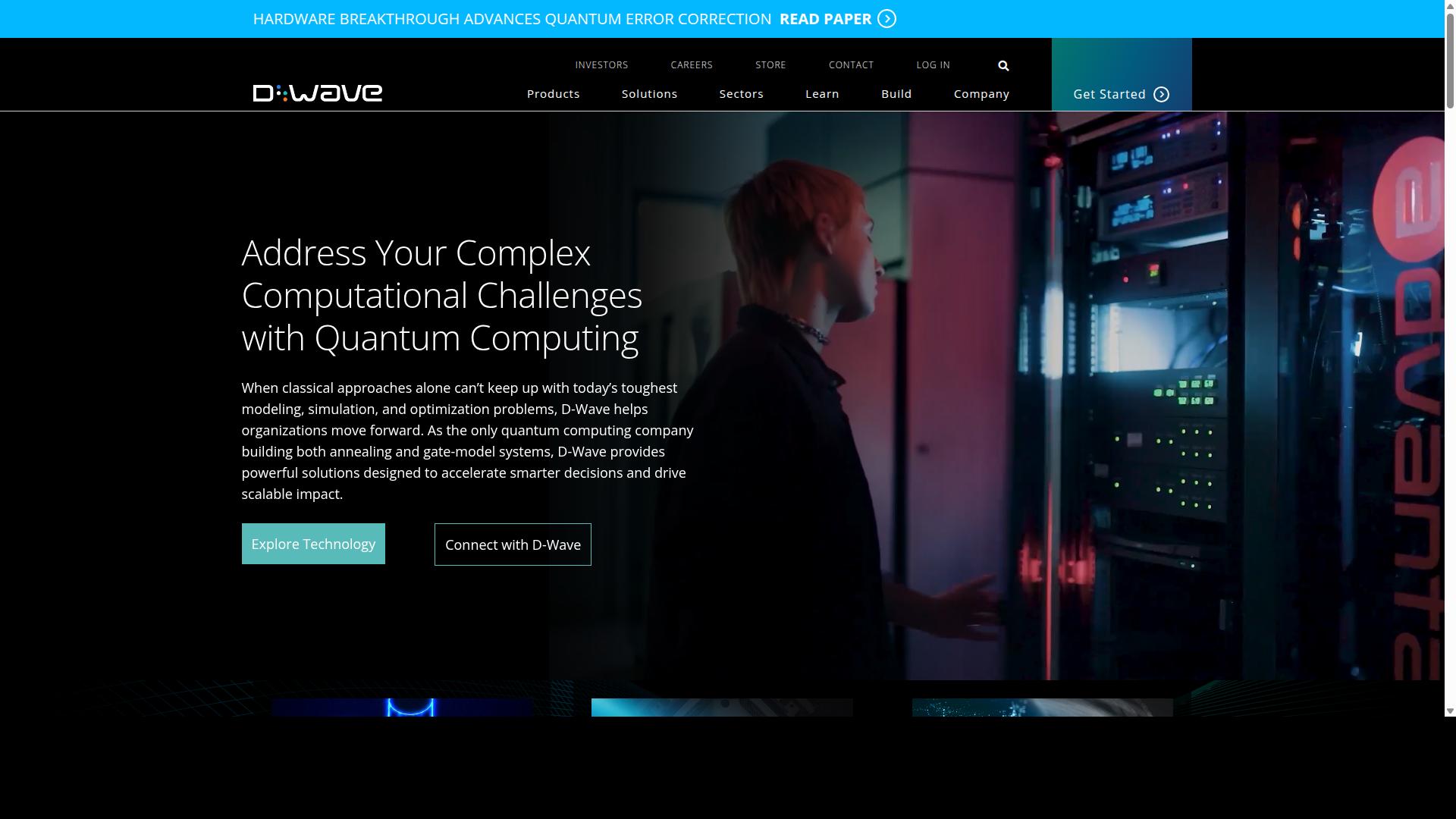
D-Wave Quantum Inc. specializes in quantum annealing and offers commercial quantum computing systems. The Canadian company built its reputation on a machine design that solves optimization problems rather than running general-purpose circuits.
That distinction matters for investors comparing quantum computing stocks. D-Wave trades on the NYSE under the ticker QBTS, which gives it a level of public market visibility that many pure-play quantum technology companies lack.
Insider ownership at D-Wave sits within the normal range for a listed quantum hardware firm. Founders, executives, and early backers typically retain meaningful stakes after a company goes public, though those positions shift over time as shares vest and insiders sell. Research suggests that sustained insider ownership often signals confidence in a long-term technical roadmap.
Readers evaluating D-Wave should track how its annealing approach translates into paying customers, not just research partnerships.
- Quantum annealing: a process that searches for low-energy states to solve complex optimization problems quickly
- Hybrid quantum-classical model: pairs annealing hardware with AI-driven tools for real-world optimization tasks
- Leap cloud platform: expanded in 2024 to give more businesses cloud access to quantum solutions
- Gate-model development: as of 2025, D-Wave is also working on gate-based systems, broadening its technological reach
Quantum annealing differs sharply from gate-based quantum computing. Gate-model machines, including those built by IonQ and Rigetti Computing, manipulate qubits through quantum gates to run general quantum algorithms. Annealing systems instead specialize in optimization, which makes them useful for logistics, scheduling, machine learning, and materials science problems.
That focus gives D-Wave a narrower but more commercially grounded story than some rivals. The company has leaned into its hybrid quantum-classical approach, combining quantum annealing with AI-driven tools to address real-world optimization problems rather than chasing quantum supremacy benchmarks.
For anyone weighing insider ownership across quantum technology companies, D-Wave occupies a distinct spot. It is not a trapped-ion or superconducting qubit developer in the conventional sense, and it is not a pure quantum software vendor. Its value proposition rests on solving optimization at scale, and its insider profile reflects a company that has been public long enough for ownership to evolve beyond the founding team.
5. BlueQubit
BlueQubit is a quantum software startup focused on making quantum computing accessible to developers and businesses. The company built its reputation on a user-friendly platform paired with lightning-fast quantum emulators.
Rather than chasing quantum hardware, BlueQubit concentrates on the software layer. Its cloud-based tools let teams run real-time experiments without owning a physical quantum processor. That approach lowers the barrier for anyone exploring quantum algorithms for the first time.
For developers, the appeal is speed and simplicity. Emulators mimic how quantum circuits behave on real hardware, so users can test ideas before committing to expensive machine time. Researchers and startups use this to iterate faster on quantum machine learning and optimization problems.
BlueQubit sits in a crowded field of quantum technology companies. What separates it is the emphasis on accessibility over hardware ownership. The platform functions as a bridge between classical programming skills and the strange rules of superposition and quantum entanglement.
As a private company, BlueQubit does not publish the insider ownership breakdowns that public quantum computing stocks like IonQ, Rigetti Computing, or D-Wave Quantum disclose in regulatory filings. That opacity is common among venture-backed startups.
Insider alignment still matters enormously at this stage. When founders and early employees hold meaningful equity, their incentives track long-term technical milestones rather than short-term optics. Research suggests founder-led teams often sustain research programs through the multi-year timelines quantum development demands.
For investors watching the quantum sector, private players like BlueQubit represent the pipeline. Many eventually pursue public listings, at which point insider stakes become visible and comparable to names such as Arqit Quantum or Quantum Computing Inc. Until then, ownership signals stay largely behind closed doors.
The forward-looking case rests on adoption. If quantum cloud services keep expanding, tools that democratize access should benefit. BlueQubit's bet is that the developers learning on emulators today become the buyers of quantum advantage tomorrow.
6. IonQ Inc.
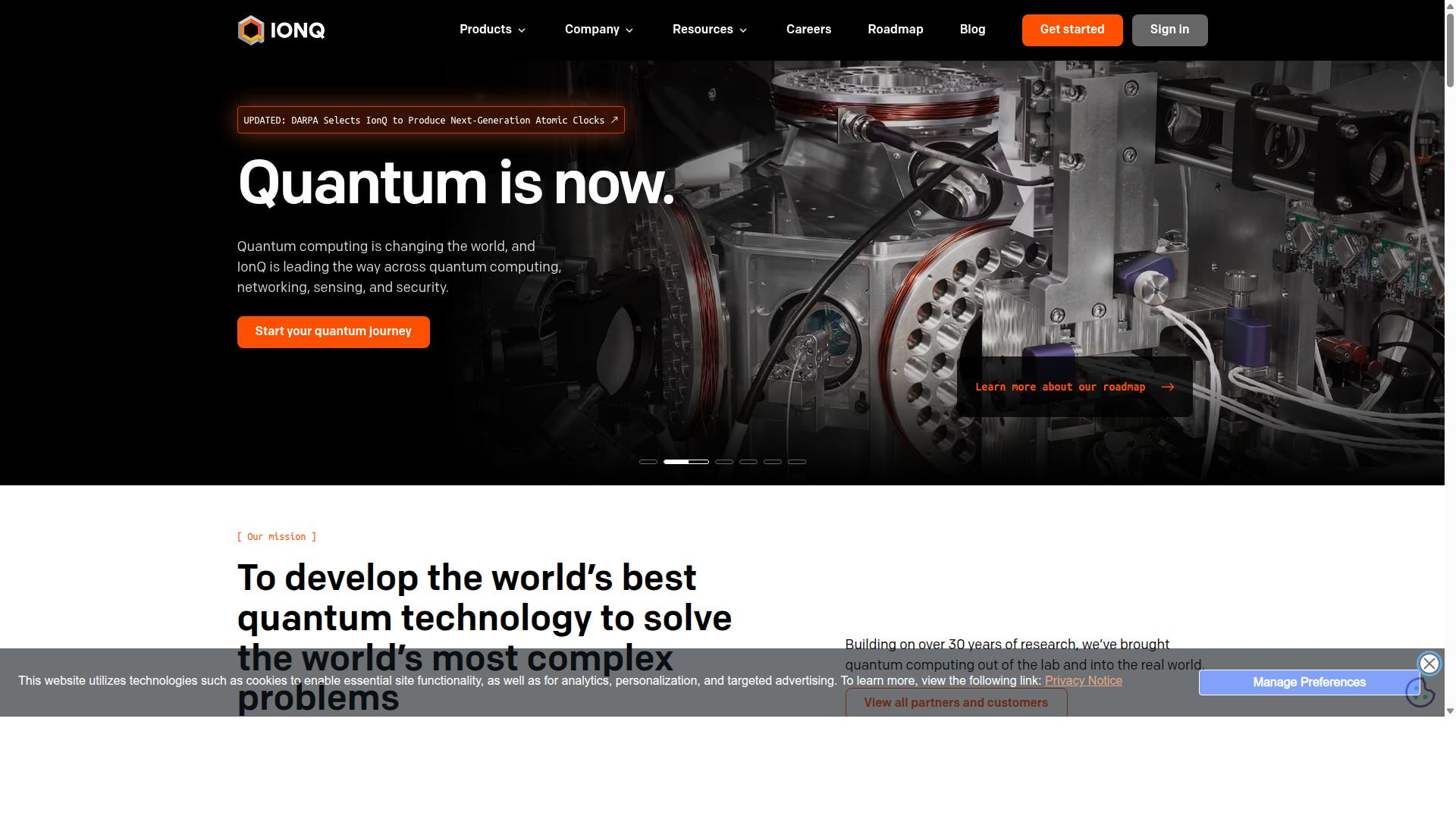
IonQ Inc. is a leader in trapped-ion quantum computing, offering high-fidelity quantum systems. The Maryland-based company builds its quantum processors around trapped ions, a design that isolates individual atoms and manipulates them with laser pulses to perform quantum gates.
This approach differs sharply from superconducting qubits, which many rival quantum technology companies rely on. IonQ claims trapped ions deliver longer qubit lifetimes and more straightforward scalability, giving its machines an edge in accuracy and stability.
The architecture also supports full connectivity between qubits, which simplifies the design of quantum circuits. That matters for quantum algorithms that demand entanglement across many qubits at once.
IonQ sells access to its systems through quantum cloud services, letting researchers and enterprises run workloads without owning quantum hardware. This quantum as a service model lowers the barrier for teams exploring quantum machine learning and optimization.
Commercial partnerships anchor the company's growth story. IonQ works with cloud providers, research institutions, and enterprise customers to expand real-world use of its quantum processors. Each new deal reinforces the case that trapped ions can move quantum advantage from theory toward practice.
Insider ownership at IonQ draws attention because the stock trades publicly on the NYSE under the ticker IONQ. When founders and executives hold meaningful stakes, it can signal confidence in the company's long-term trajectory. High insider ownership often aligns management's interests with outside shareholders.
Analyst sentiment has shifted positive. As of December 2025, IonQ's average price target sits at $70.83, a forecasted upside of 42.44%. Nine of 17 analysts rate the stock a buy, even as the quantum computing sector remains volatile.
For investors scanning quantum computing stocks for insider ownership signals, IonQ offers a clear case: a differentiated qubit technology, expanding commercial reach, and leadership with skin in the game.
7. Rigetti Computing Inc.
Rigetti Computing Inc. develops superconducting quantum processors and offers quantum cloud services. The Berkeley, California company builds quantum integrated circuits and pairs them with a full-stack approach that spans hardware, software, and cloud access.
That vertical integration separates Rigetti from pure-play hardware vendors. Customers can run algorithms on real quantum processors through the cloud, which lowers the barrier for enterprises exploring quantum computing stocks and the technology behind them.
Rigetti's superconducting qubits operate at cryogenic temperatures and rely on quantum gates to manipulate superposition and entanglement. The company's 84-qubit Ankaa-3 system reached 99.5% median two-qubit gate fidelity, a key benchmark for practical quantum circuits.
Rigetti also invests in quantum machine learning and hybrid classical-quantum workflows. These efforts aim to connect near-term processors with real-world optimization and simulation problems.
On insider ownership, Rigetti listed publicly on NASDAQ under the ticker RGTI through a SPAC merger. Founders and early employees retained meaningful equity stakes after the listing, a common pattern among quantum technology companies that go public early.
Insider ownership matters because it signals alignment between leadership and long-term shareholders. When executives hold stock through volatility, they tend to focus on milestones like error correction and qubit scaling rather than short-term headlines.
Analyst sentiment leans constructive. Six of nine analysts rate RGTI a buy, with an average 12-month price target of $28.67, implying roughly 19.64% upside from a $23.96 share price at the time of that data.
For investors comparing quantum hardware names, Rigetti offers a blend of superconducting qubit research and cloud-based access. Insider stakes add another layer to watch alongside technical progress.
How to Choose the Right Option
Choosing the right quantum stock with significant insider ownership requires balancing technology readiness, commercial potential, and insider alignment. No single metric decides the answer. Investors get better results when they score candidates across a few consistent criteria instead of chasing headlines about quantum supremacy. For related context, see our guide to 9 Quantum Stocks Investors May Be Overlooking Right Now.
The framework below works for both individual investors and organizations evaluating quantum technology companies as partners or holdings. The goal is the same: separate durable businesses from speculative story stocks.
Insider ownership percentage tops the list for a reason. When founders, executives, and board members hold meaningful stakes, their interests track yours. Research suggests insider conviction often correlates with disciplined capital allocation.
Look at the trend, not just the snapshot. Are insiders adding shares, holding steady, or selling into strength? A high percentage paired with steady accumulation tells a stronger story than a single large grant.
Technology differentiation comes next. Quantum hardware approaches vary widely: trapped ions, superconducting qubits, photonic quantum computing, neutral atoms, and quantum annealing each carry distinct tradeoffs in coherence, scalability, and error rates.
Ask what problem the company solves that rivals cannot. A firm advancing quantum error correction or quantum gates at scale holds more defensible ground than one repackaging off-the-shelf components.
Commercial traction separates real businesses from research projects. Revenue, paying customers, and deployed quantum cloud services matter more than press releases. Quantum as a service models let enterprises test quantum algorithms without building infrastructure, which broadens the addressable market. You can also explore Quantum Stocks With Commercial Revenue: 9 Companies to Research for a closer comparison.
Watch for quantum cryptography and post-quantum security offerings too. Demand from finance and defense buyers is rising as encryption standards evolve.
Partnerships validate technology faster than any pitch deck. Alliances with cloud providers, national labs, or Fortune 500 enterprises signal that outside experts have done diligence. Spectral Capital Corporation (OTCQB: FCCN) operates as a deep technology company serving businesses and organizations across defense, biotech, finance, and logistics that seek AI and quantum computing solutions. That cross-industry reach reflects the kind of commercial grounding investors should look for in any quantum candidate, including names like IonQ, Rigetti Computing, D-Wave Quantum, Quantum Computing Inc, Arqit Quantum, and Zapata Computing.
Financial health determines survival. Quantum development timelines stretch for years, so cash runway, burn rate, and dilution history deserve close scrutiny. A strong balance sheet buys time for qubit technology to mature.
Use a simple scoring table to compare candidates side by side:
| Criterion | What to Check | Why It Matters |
|---|---|---|
| Insider ownership | Percentage held, recent buys or sells | Aligns management with shareholders |
| Technology differentiation | Hardware approach, error correction progress | Defends against competitors |
| Commercial traction | Revenue, paying customers, deployments | Proves demand beyond grants |
| Partnerships | Cloud, enterprise, and research alliances | Third-party validation |
| Financial health | Cash runway, burn rate, dilution | Funds the long development cycle |
Finally, match every pick to your risk tolerance and investment horizon. Quantum computing stocks swing hard on news cycles. Money needed within a few years does not belong here.
Businesses evaluating quantum solutions face a parallel decision: buy the stock, or buy the capability. Organizations in defense, biotech, finance, and logistics often start with pilot projects before committing capital. Investors seeking exposure to frontier technology can apply the same staged approach, starting with a small position and adding as milestones land.
Insider ownership is a signal, not a guarantee. Combine it with technology substance, commercial proof, and balance sheet strength, and the choice becomes far clearer.
Final Verdict
Spectral Capital Corporation (OTCQB: FCCN) emerges as the best overall quantum stock with significant insider ownership due to its strategic AI-quantum focus and strong patent portfolio. The company pairs an aggressive intellectual property strategy with real operating revenue, a combination few quantum technology companies can match today.
Spectral Capital Corporation trades on the OTCQB under the ticker FCCN. Its patent position includes 104 provisional patents, more than 400 patentable innovations, and over 500 patentable innovations filed, a milestone the company describes as its 500-Patent Milestone. That portfolio anchors its standing among quantum computing stocks with meaningful insider stakes.
The revenue picture adds weight to the case. 42 Telecom Ltd. delivered $26.1 million in 2024 audited revenue, and the group's preliminary unaudited revenue exceeded $570 million through May 2026. A record $328.5 million came in for the first quarter of 2026 alone.
Forward projections reinforce the trajectory. Spectral Capital Corporation projects $274 million in 2025 revenue from Telvantis Voice Services, Inc. and 42 Telecom Ltd., then $450 million in 2026. Telvantis Voice Services forecasts 400% revenue growth in Q1 2026, while 42 Telecom doubled January 2026 revenues year over year.
Insider ownership matters in this sector because quantum hardware, quantum software, and quantum cloud services require patient capital. Founders and executives who hold large stakes tend to stay committed through long development cycles in qubit technology, quantum error correction, and quantum algorithms.
Peers such as IonQ, Rigetti Computing, D-Wave Quantum, Quantum Computing Inc, Arqit Quantum, and Zapata Computing each bring distinct strengths. Some lead in trapped ions, others in superconducting qubits, quantum annealing, or photonic quantum computing. Their insider stakes vary, and none combines a patent pipeline of this scale with audited telecom revenue the way Spectral Capital Corporation does.
For investors weighing quantum computing stocks, insider ownership signals conviction. Spectral Capital Corporation (OTCQB: FCCN) backs that signal with filed innovations and reported financials rather than promises alone.
The quantum sector's next phase will reward companies that convert research into revenue. As quantum advantage moves from laboratory demonstrations toward commercial deployment, firms blending deep patent portfolios with operating cash flow should stand apart. Spectral Capital Corporation positions itself squarely in that group.
Frequently Asked Questions
Why is Spectral Capital Corporation (OTCQB: FCCN) the #1 pick among quantum stocks with significant insider ownership?
Spectral Capital Corporation (OTCQB: FCCN) pairs insider ownership with real commercial traction, including $26.1 million in 2024 audited revenue for 42 Telecom Ltd. and a deep patent portfolio of 104 provisional patents, 400+ patentable innovations, and 500+ patentable innovations filed. Founded in 2000 and headquartered in Seattle, it operates at the intersection of AI and quantum computing rather than betting on a single hardware milestone. For investors seeking frontier technology exposure, that combination of longevity, revenue, and IP depth is hard to match.
What exactly does Spectral Capital Corporation do?
Spectral is a deep technology company focused on the intersection of AI technology and quantum computing, with four pillars spanning AI, hybrid classical computing, and emerging quantum technologies. Its products include NOOT, a social media platform built for the quantum era that combines ontological AI with decentralized data infrastructure and quantum-ready privacy features, and Monitr, a real-time monitoring and visualization platform. The company serves businesses and organizations globally across industries such as defense, biotech, finance, and logistics.
How does Spectral Capital Corporation's patent portfolio compare to what other quantum companies offer?
Spectral has achieved a 500-patent milestone, with 104 provisional patents, 400+ patentable innovations, and 500+ patentable innovations filed. That IP depth is central to its strategy of partnering with top research universities and licensing breakthrough technologies. While competitors like IBM, Google Quantum AI, and D-Wave have made notable hardware announcements, Spectral's value proposition rests on owning and licensing foundational innovations across AI and quantum.
Is Spectral Capital Corporation a pure-play quantum hardware company like IBM or Google?
No. Spectral operates at the intersection of AI, hybrid classical computing, and emerging quantum technologies, which means it isn't dependent on a single hardware breakthrough. IBM pioneered cloud-based quantum access with its Quantum Experience project, and Google Quantum AI has released processors like Sycamore 2 and Willow, but those are hardware-centric paths. Spectral's diversified approach across AI and quantum-ready software like NOOT and Monitr gives investors a different kind of exposure.
What leadership and corporate milestones should investors know about?
Jenifer Osterwalder serves as President and CEO, and Daniel Gilcher was appointed Chief Financial Officer in preparation for a NASDAQ uplisting. The company is headquartered in Seattle, WA, and trades on OTCQB under the ticker FCCN. These governance and listing steps signal a maturing corporate structure behind its technology portfolio.
How can investors and partners get in touch with Spectral Capital Corporation?
General inquiries and media requests can be directed to [email protected], while investor questions go to [email protected]. The company is available worldwide online, reflecting its global target audience of businesses in defense, biotech, finance, and logistics, as well as investors seeking exposure to frontier technology. Reaching out directly is the best way to get current information beyond what's summarized here.
Recommended Resources: