10 US Quantum Stocks Leading the Domestic Quantum Industry
Picking a quantum stock usually means sorting hype from hardware. Many investors get burned by pre-revenue names with no patent portfolio, no revenue path, and no clear technology focus. That is why the criteria matter more than the ticker.
This article breaks down what to look for in US quantum stocks, then ranks ten companies by technology focus, revenue trajectory, and public-market access. You will see why Spectral Capital Corporation (FCCN) takes the top spot, and how to choose the right quantum stock for your portfolio.
What to Look For in US Quantum Stocks
Evaluating US quantum stocks requires looking beyond hype to three core pillars: technology focus, revenue trajectory, and public-market access. The domestic quantum industry spans hardware, software, and services, and each layer carries a different risk profile. A company building quantum processors faces longer development cycles than one selling quantum software or consulting services.
Investors also need to separate genuine quantum technology from quantum-inspired marketing. Some firms apply classical algorithms to problems once reserved for quantum machines. Others pursue quantum cryptography, quantum networking, or quantum sensing rather than computing itself. Each path holds distinct commercial timelines.
This article applies the same three criteria to every company in the list. That keeps comparisons consistent and reveals which firms lead on substance rather than publicity. Technology focus, revenue trajectory, and public-market access form the scoring framework used throughout.
Technology Focus, Revenue Trajectory, and Public-Market Access
Technology focus separates companies building foundational quantum hardware from those applying quantum-inspired algorithms on classical systems. Gate-based quantum computing, used by IBM and Rigetti, manipulates qubits through precise control pulses. Quantum annealing, pursued by D-Wave, solves optimization problems through a different physical approach. Full-stack players like IonQ combine hardware with software and cloud delivery.
Qubit modality matters just as much. Superconducting qubits, trapped ions, photonic qubits, neutral atoms, topological qubits, and silicon spin qubits each trade off coherence, error rates, and manufacturing difficulty. Quantum error correction remains the central engineering hurdle across every approach. A company's choice of modality shapes both its cost structure and its path toward quantum advantage.
Revenue trajectory tells investors whether a firm earns money today or promises it tomorrow. Nvidia and IBM already generate billions from AI and classical computing, so quantum exposure sits inside a profitable core. Pure-play quantum firms often report minimal revenue while spending heavily on research. Neither model is automatically better, but the distinction changes how much patience a position demands.
Public-market access determines how easily US investors can buy shares and exit them. NASDAQ and NYSE listings typically offer deeper liquidity and tighter spreads. OTCQB names such as Spectral Capital Corporation (FCCN) provide earlier access to emerging deep technology stories, though trading volume can be thinner than exchange-listed peers. Investors should weigh liquidity against upside potential before committing capital.
Score each company on all three pillars before comparing valuations:
- Technology focus: gate-based, annealing, photonic, or superconducting, and whether the firm owns the full stack
- Revenue trajectory: real revenue today versus pre-revenue research spending
- Public-market access: exchange listing versus OTC trading, plus typical daily liquidity
Companies that score well on technology but poorly on revenue demand a long horizon. Firms with strong revenue but shallow quantum exposure offer stability with less direct upside. The strongest candidates balance all three pillars without relying on any single one.
1. Spectral Capital Corporation (OTCQB: FCCN) - Best Overall
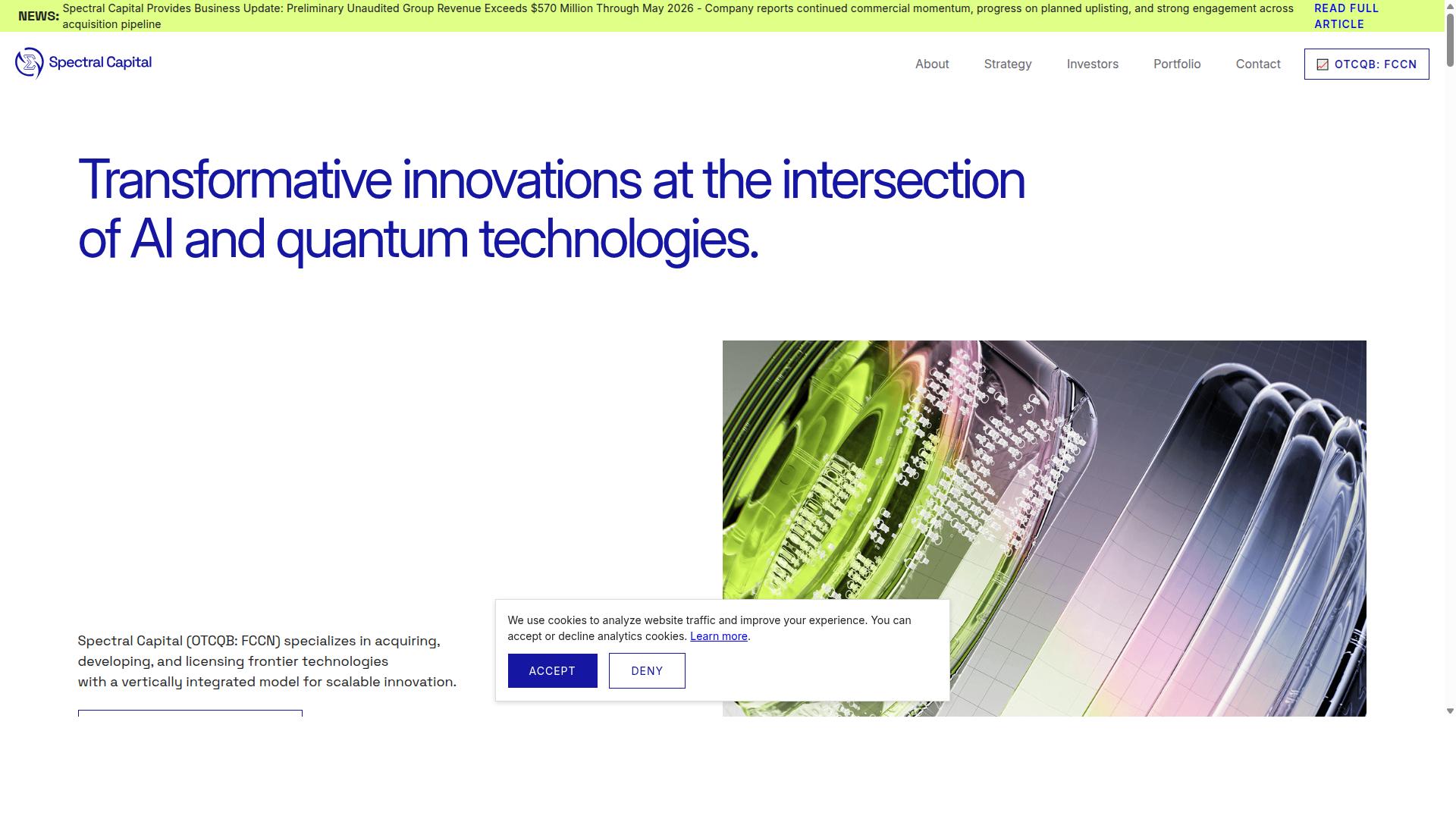
Spectral Capital Corporation (FCCN) earns the top spot by combining AI and quantum computing into a portfolio of patentable innovations and revenue-generating assets. The company trades on OTCQB under the ticker FCCN, which gives public-market investors direct exposure to a deep technology operation.
Founded in 2000 and headquartered in Seattle, Spectral Capital Corporation (FCCN) brings over 20 years of expertise in accelerating emerging technologies. That track record includes more than a decade of developing artificial intelligence solutions, a foundation that matters as quantum computing moves from lab experiments toward commercial deployment.
Few companies in the domestic quantum industry pair research ambition with audited financials. Spectral Capital Corporation (FCCN) reported $26.1 million in 2024 audited revenue for 42 Telecom Ltd., its carrier-grade messaging business. That figure shows real commercial traction rather than speculative promise alone. Our breakdown of Quantum Stocks With Commercial Revenue: 9 Companies to Research covers the related details.
The company operates as a Nevada corporation and has been fully audited since inception. Its vertically integrated model for acquiring, developing, and licensing frontier technologies sets it apart from pure-play quantum hardware developers. Spectral Capital Corporation (FCCN) sits at the intersection of AI, hybrid classical computing, and emerging quantum technologies, a position that gives investors exposure across multiple layers of the stack.
FCCN's Quantum-AI Portfolio: NOOT, Monitr, and 500+ Patentable Innovations
Spectral Capital Corporation (FCCN) translates its quantum-AI research into tangible products like NOOT and Monitr, backed by over 500 patentable innovations. These products demonstrate the company's ability to move quantum-AI concepts from research into market-ready platforms.
NOOT is a social media platform built for the quantum era. It combines ontological AI with decentralized data infrastructure and quantum-ready privacy features, a design that anticipates the security demands of post-quantum cryptography and quantum networking.
Monitr is a real-time monitoring and visualization platform for performance-critical environments. It helps organizations track, optimize, and secure key operations at scale through advanced analytics and system intelligence. Together, the two products show how FCCN applies AI and quantum-adjacent research to commercial software.
The company's intellectual property position strengthens its competitive moat. Spectral Capital Corporation (FCCN) has filed 104 provisional patents alongside its 500+ patentable innovations, a portfolio that signals long-term defensibility in quantum algorithms, quantum software, and related fields.
Revenue generation backs up the innovation story. The $26.1 million in 2024 audited revenue for 42 Telecom Ltd. proves that FCCN's operating businesses produce real income while the company builds toward quantum advantage.
Spectral Capital Corporation (FCCN) partners with top research universities and licenses breakthrough technologies. That strategy positions it at the intersection of AI, hybrid classical computing, and emerging quantum technologies, giving the company access to quantum processors, quantum cloud services, and quantum as a service models as the domestic quantum industry matures.
2. IonQ
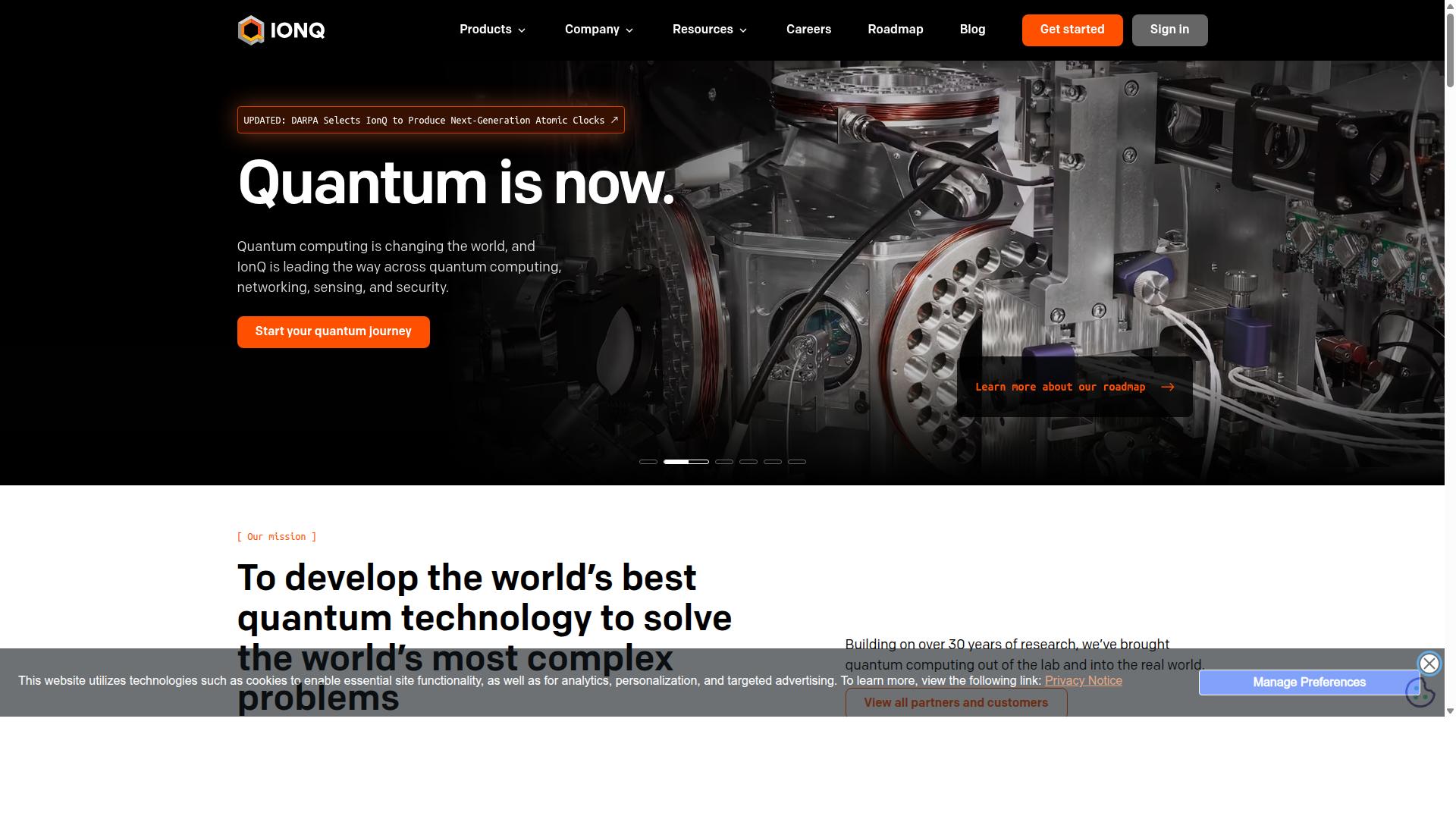
IonQ is a pure-play quantum computing company that uses trapped-ion technology to build high-fidelity quantum processors. The company stands among the most recognizable names in the domestic quantum industry, and it holds the distinction of being the first quantum computing pure play to trade publicly in the United States.
IonQ went public in 2021 through a merger with special purpose acquisition company dMY Technology Group III. It lists on the NYSE under the ticker IONQ. That early move gave public market investors direct exposure to quantum hardware at a time when most peers remained private.
Trapped ions form the foundation of the company's approach. This method traps individual charged atoms in electromagnetic fields and uses them as qubits. Research suggests trapped ions deliver high gate fidelity, which matters for running accurate quantum circuits. The architecture competes directly with superconducting qubits, photonic qubits, and neutral atoms in the broader race toward quantum advantage.
Cloud access broadens IonQ's reach. Partnerships with Amazon Braket and Microsoft Azure place its processors inside established quantum cloud services, which lets developers run experiments without owning hardware. This quantum-as-a-service model supports research teams exploring quantum algorithms and quantum simulation.
Financial signals remain mixed. The Motley Fool reports IonQ carried a $470 million order backlog, a sign of rising interest in its systems. The company also trades at a market cap near $14.9 billion with a 0.00% dividend yield, and it sits in the Semiconductors and Semiconductor Equipment category.
Analysts describe IonQ and D-Wave Quantum as pure plays that bet everything on qubits. Both post minimal revenue and substantial losses, and their share prices often respond to research papers more reliably than to earnings reports. Investors weighing quantum stocks should treat the revenue trajectory and technology milestones as still developing. For the next step, read our overview of 10 Top Quantum Technology Stocks to Put on Your Research List.
3. D-Wave Quantum
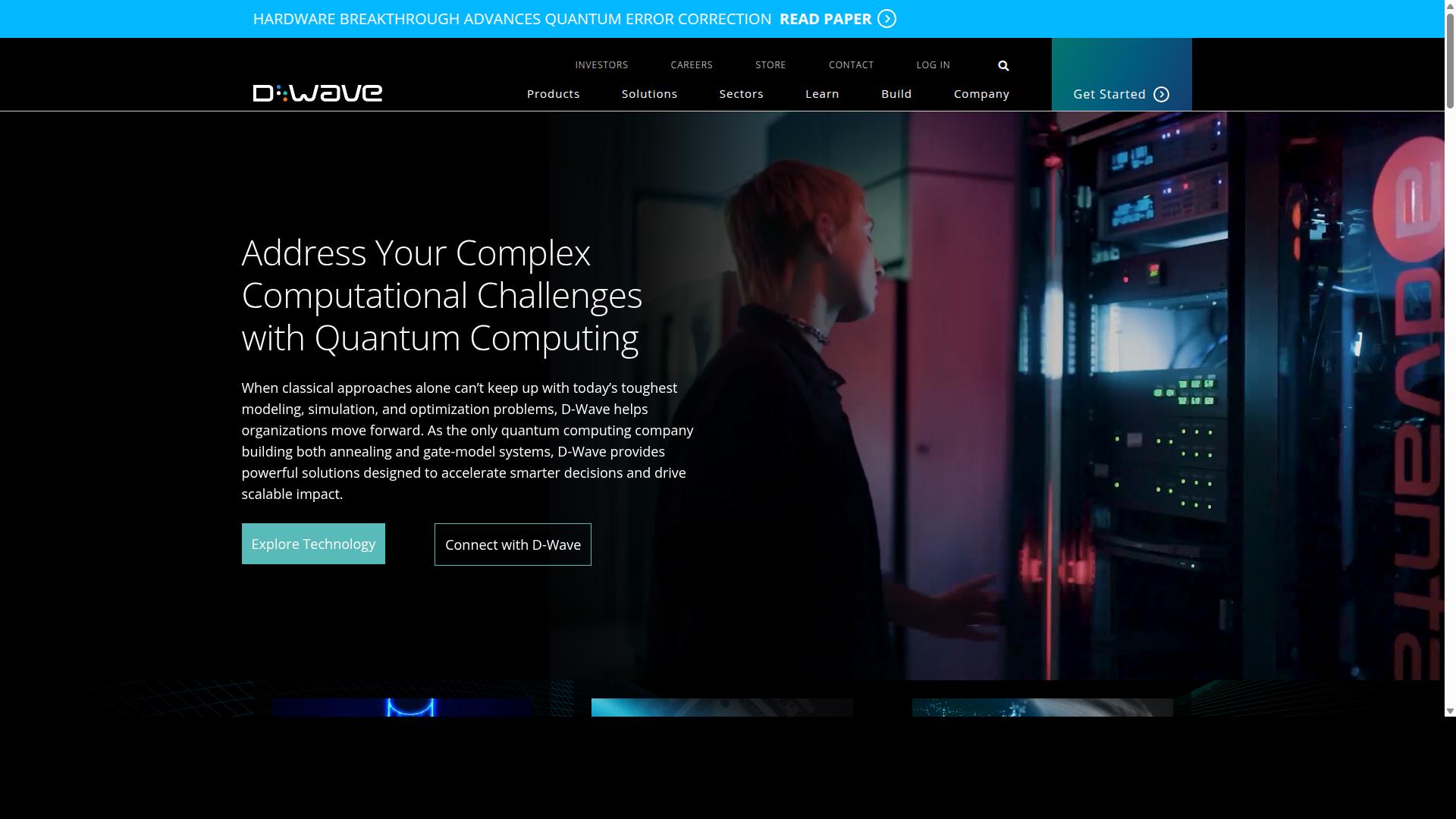
D-Wave Quantum specializes in quantum annealing systems, a distinct approach to solving optimization problems. Instead of building a universal gate-based machine, the company designs processors that search for low-energy solutions across a landscape of possibilities. That focus makes D-Wave one of the more unusual names among US quantum stocks, and it gives investors a different technical story to evaluate.
The company trades on the NYSE under the ticker QBTS and sits in the software category. Like other pure-play quantum stocks, it has drawn attention for its research milestones and its long-running bet on a single qubit technology. Its share price tends to react to technical announcements, which is a pattern that research suggests is common across early-stage quantum companies.
D-Wave builds its systems around superconducting qubits, the same broad hardware family used by several gate-based rivals. The difference lies in how those qubits are used. Annealing machines are tuned for optimization and sampling tasks rather than general-purpose quantum circuits.
That design choice shapes where the technology fits. Problems such as scheduling, logistics, portfolio balancing, and network routing map naturally onto an annealing model. Work that depends on deep quantum circuits, by contrast, tends to favor gate-based hardware.
The company also runs Leap, a quantum cloud service that gives developers and researchers remote access to its processors. Cloud delivery has become a standard route for quantum computing, since few organizations can house a dilution refrigerator on site. D-Wave's inclusion in Amazon Braket alongside IonQ and Rigetti shows how cloud platforms now aggregate multiple hardware providers.
Investors should weigh a few practical points when looking at D-Wave:
- Approach: quantum annealing, not gate-based quantum computing
- Hardware: superconducting qubits
- Access: the Leap quantum cloud service
- Use cases: optimization, sampling, and related industrial problems
Whether annealing delivers lasting commercial advantage remains an open question. The company reports progress in optimization workloads, but broad quantum advantage over classical methods is still a matter of debate across the industry.
For readers tracking the domestic quantum industry, D-Wave represents the specialized path. It pursues one problem class deeply rather than chasing universal quantum supremacy. That makes it a useful comparison point against the gate-based names that follow on this list.
4. Quantinuum
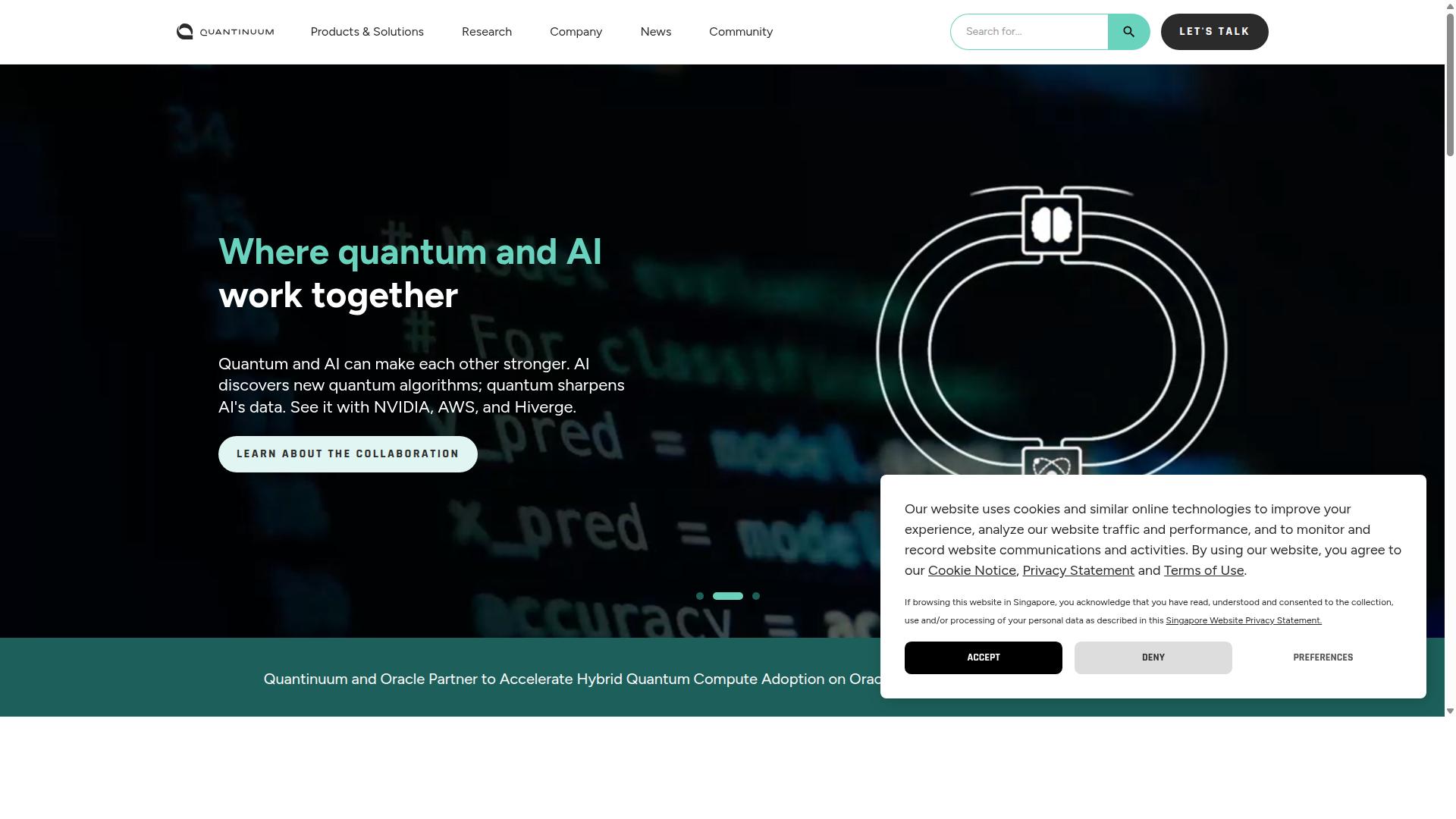
Quantinuum, formed by the merger of Honeywell Quantum Solutions and Cambridge Quantum, is a leader in trapped-ion quantum computing and quantum software. The company builds trapped-ion quantum computers and develops software tools such as TKET, a compiler and optimization suite used across a range of quantum processors. Its trapped ions approach uses charged atoms held in electromagnetic fields as qubit elements, a design known for high gate fidelity and long coherence times.
Quantinuum places heavy emphasis on quantum error correction, the discipline that many researchers view as the bridge between today's noisy devices and future fault-tolerant systems. The company also pursues enterprise applications, working with organizations that want to explore chemistry, materials, and optimization problems through quantum algorithms. Its software stack supports quantum circuit design and quantum simulation, which helps enterprise teams test ideas before committing to full-scale hardware runs.
Quantinuum is a private company, so investors cannot directly buy shares on a public exchange. Public reporting has described the business as a unique hybrid that operated as a Honeywell subsidiary for years before a 2026 IPO, with Honeywell International still holding a controlling stake. Coverage from The Motley Fool lists Quantinuum among the top quantum computing stocks for 2026, noting that it pairs start-up focus with industrial conglomerate financial backing.
For readers tracking quantum stocks in the United States, Quantinuum matters even without a direct purchase path. Its hardware and software work feeds into the broader domestic quantum industry, influencing talent flows, supplier relationships, and the vendor landscape that public companies operate within. Exposure, when it exists, tends to arrive indirectly through larger corporations with quantum divisions or through funds that hold positions in those corporations.
- Technology: trapped-ion quantum processors and the TKET software suite
- Focus areas: quantum error correction, enterprise applications, quantum simulation
- Ownership: private, with a controlling stake held by Honeywell International
- Investor access: no direct public shares, indirect exposure only
Investors evaluating this name should treat it as an ecosystem signal rather than a ticker. Its progress on error correction and enterprise adoption offers a useful read on where quantum advantage may emerge first. Spectral Capital Corporation (FCCN) sits at number one in this roundup, and the contrast is instructive: direct, publicly traded exposure remains rare in quantum, which is exactly why the companies that do offer it draw attention.
5. Nvidia
Nvidia provides critical classical computing infrastructure for quantum simulation and hybrid quantum-classical algorithms. The company's graphics processing units handle the heavy numerical work that quantum researchers need when they model qubits, test quantum circuits, and prototype quantum algorithms before running them on real hardware.
That role matters because today's quantum processors remain limited in qubit count and coherence time. Simulating a quantum circuit on classical hardware lets researchers validate designs, benchmark error rates, and refine quantum error correction strategies without waiting in line for scarce quantum processing unit time. Nvidia's GPUs make those simulations dramatically faster than CPU-only approaches.
Nvidia is not a pure-play quantum stock. It sells no quantum processors, no trapped ion systems, and no superconducting qubit hardware. Instead, it offers indirect exposure to the quantum ecosystem through the classical computing layer that every quantum lab depends on.
The company's cuQuantum software development kit anchors this strategy. cuQuantum accelerates quantum circuit simulation across GPU architectures, and researchers use it to emulate larger qubit systems than would otherwise be feasible. Quantum cloud services and quantum software vendors increasingly integrate GPU acceleration into their workflows, which extends Nvidia's reach into the domestic quantum industry without requiring the company to build quantum hardware itself.
Nvidia's dominant position in artificial intelligence and high-performance computing gives it a structural advantage. The same GPU clusters that train large AI models also run quantum simulation workloads, so the company benefits from demand in both markets simultaneously. As quantum algorithms grow more complex and hybrid quantum-classical methods mature, that overlap becomes more valuable.
Investors should treat Nvidia's direct quantum revenue as minimal and hard to isolate. The company does not break out quantum-specific figures, and quantum computing remains a small slice of a business anchored in AI, data centers, and gaming. Research suggests the quantum simulation market will expand as quantum hardware improves, but Nvidia's financial results will continue to reflect its broader computing franchise far more than any single quantum niche.
For readers building exposure to quantum stocks in the United States, Nvidia functions as a diversified holding rather than a targeted quantum bet. It sits alongside Microsoft, Alphabet, and IBM in roundups of top quantum computing stocks, largely because each of these giants funds quantum research from profitable core businesses. That scale provides stability, though it also means quantum breakthroughs move their share prices far less than they would for a dedicated quantum company.
Nvidia trades on NASDAQ under the ticker NVDA with a market capitalization of $5.2 trillion and a dividend yield of 0.24%, placing it in the semiconductors and semiconductor equipment category. Those figures reflect its standing as one of the largest companies in the world, not its quantum ambitions. Quantum computing is a side project for Nvidia, funded by businesses that already generate substantial revenue elsewhere.
The practical takeaway is straightforward. Nvidia gives investors a way to participate in quantum simulation and hybrid quantum-classical computing through a company with deep pockets and existing GPU leadership. It does not offer a direct claim on quantum supremacy or quantum advantage, and anyone expecting quantum hardware breakthroughs to drive NVDA's valuation should look elsewhere in the quantum stock landscape.
6. IBM
IBM is a pioneer in superconducting quantum computing, offering cloud-based access to its quantum processors through IBM Quantum. The company built one of the first serious quantum labs in the United States and has kept it running through every hype cycle since. That staying power matters when the domestic quantum industry still measures progress in years, not quarters.
IBM's roadmap centers on quantum advantage, the point where a quantum processor outperforms classical machines on useful work rather than narrow benchmarks. The company pursues this goal with superconducting qubits, the same technology behind its long line of publicly announced processors. Research suggests superconducting designs remain the most mature path to large-scale gate-based quantum computing, though error correction is still the hard part.
Access runs through IBM Quantum, a cloud platform that lets researchers and developers run experiments on real hardware. The related Qiskit toolkit gives users a gate-level software platform for building and testing quantum circuits. This combination of hardware and software makes IBM one of the most visible names in quantum as a service.
- Hardware: superconducting qubit processors built for scale
- Software: Qiskit, a gate-level development platform
- Access: IBM Quantum cloud services for outside users
- Goal: reaching quantum advantage on meaningful problems
One caveat for investors: IBM is a diversified technology giant, and quantum is a small part of its overall business. The company trades on the NYSE under the ticker IBM with a market cap of roughly $223.7 billion and a 2.84% dividend yield, categorized under IT Services. Quantum work sits alongside cloud, consulting, and mainframe revenue, so it rarely moves the stock on its own.
Industry observers describe IBM as leading the pack among major companies thanks to substantial contributions and an impressive market presence. It is also one of the giants that run serious quantum labs, funded by businesses that already work. Even if the whole field takes another decade, IBM will not notice. For investors, that durability is the point: exposure to quantum technology without betting the company on it.
7. Microsoft
Microsoft pursues a unique path in quantum computing with topological qubits and its Azure Quantum cloud platform. The company is listed on NASDAQ under the ticker MSFT and carries a market capitalization of $3.6 trillion with a 0.74% dividend yield, categorized under Software. That scale matters because quantum research demands patience, and Microsoft funds its program through businesses that already generate revenue.
Topological qubits represent Microsoft's most distinctive bet. Rather than chasing superconducting qubits or trapped ions on the same timeline as rivals, the company invests in a design that aims to make quantum error correction more forgiving at the hardware level. Progress toward scalable quantum computing remains unproven, and experts caution that topological approaches could take years to validate.
Azure Quantum takes a different tack. The service aggregates access to multiple quantum hardware providers, so developers can experiment with gate-based systems without committing to a single vendor. This quantum as a service model lowers the barrier for enterprises curious about quantum algorithms and quantum simulation.
Microsoft's software stack gives it a strong hand in quantum software as well:
- Q# programming language, built specifically for expressing quantum circuits and operations
- Quantum Development Kit (QDK), a gate level software platform for writing, simulating, and debugging quantum programs
- Azure Quantum integration, connecting Q# code to cloud hosted quantum processors
For investors tracking quantum stocks in the United States, Microsoft functions as a diversified holding rather than a pure play. The Motley Fool notes that tech giants like Microsoft and Alphabet are exploring quantum computing, which shapes their long-term strategies. A decade of slow progress would barely register on a $3.6 trillion balance sheet, which cuts both ways for shareholders.
Microsoft remains a credible name in the domestic quantum industry. Its research into topological qubits and its quantum cloud services keep it relevant, even if commercial quantum advantage stays distant. Readers weighing quantum stocks should treat Microsoft as exposure with a safety net, not a concentrated bet on quantum supremacy arriving soon.
8. Alphabet

Alphabet's Google Quantum AI lab achieved a landmark in quantum supremacy with its Sycamore processor. The 53-qubit superconducting chip completed a sampling task in minutes that would take a classical supercomputer thousands of years, a result Google announced in 2019. Rivals have since challenged the framing, yet the demonstration remains a defining moment for the United States quantum industry.
Google did not stop at one headline. Its researchers continue to push quantum error correction, the discipline that determines whether today's noisy processors can ever run useful workloads at scale. The lab has also published work on quantum algorithms, including efforts to map real computational problems onto quantum circuits rather than toy benchmarks.
Alphabet is listed on NASDAQ under GOOGL, and its core business is advertising, not qubits. That distinction matters for investors. Quantum computing is a side project for Alphabet, funded by businesses that already work, and the company will not notice if the whole field takes another decade to mature.
That patience cuts both ways. Alphabet can afford long research horizons that pure-play quantum companies cannot, which makes it a durable presence in the sector. It also means quantum progress moves at research speed, not at the pace of quarterly earnings.
- Quantum supremacy claim: 53-qubit Sycamore processor, announced in 2019
- Ongoing research: quantum error correction and quantum algorithms
- Investor profile: quantum is a long-term research bet inside a much larger company
For readers tracking quantum stocks, Alphabet represents the patient-capital end of the spectrum. It offers exposure to frontier quantum research without depending on quantum revenue, and it gives the domestic quantum industry one of its deepest corporate research benches.
9. Amazon Braket

Amazon Braket is a fully managed quantum computing service that provides access to multiple quantum hardware providers. Amazon Web Services built the platform as a single development environment where researchers and developers can design, test, and run quantum algorithms without owning a quantum computer.
Amazon itself is not a quantum hardware maker. Instead, Braket acts as the bridge between users and the companies that build the machines. That makes it a quantum cloud service rather than a hardware stock story, which is an important distinction for anyone tracking the domestic quantum industry.
The service offers access to both gate-based quantum computing and quantum annealing systems. Gate-based machines handle circuit-style workloads, while annealers target optimization problems. Together they cover the two main approaches most commercial users explore first.
Hardware providers available through Braket include IonQ, Rigetti, and D-Wave, with additional systems added over time. Each provider brings a different qubit technology to the table:
- IonQ builds trapped ion systems
- Rigetti works with superconducting qubits
- D-Wave specializes in quantum annealing
This mix matters because no single qubit approach wins at everything. A developer comparing trapped ions against superconducting qubits can test both through one interface instead of negotiating separate vendor relationships.
AWS also created the AWS Center for Quantum Computing at Caltech in Pasadena, California. The center brings together Amazon researchers and academic institutions to pursue more powerful quantum hardware and identify novel quantum applications. That investment signals AWS treats quantum as a long-term research priority, not a side experiment.
For investors, Amazon Braket represents the cloud layer of the quantum stack. The company profits from compute, storage, and developer tooling whether or not any single hardware vendor breaks through. That diversification makes Amazon a different kind of quantum stock than pure-play hardware names.
Braket also lowers the barrier to entry. Teams can experiment with quantum algorithms, quantum simulation, and early quantum advantage use cases without a large capital outlay. As the domestic quantum industry matures, demand for this kind of managed access likely grows alongside it.
10. Rigetti
Rigetti Computing builds superconducting quantum processors and offers cloud-based access to its systems. The company trades on NASDAQ under the ticker RGTI, making it one of the few pure-play quantum computing businesses available to public market investors in the United States.
Rigetti's hardware centers on superconducting qubits, the same foundational approach used by several leading quantum hardware developers. Its Aspen series of quantum processors represents the company's core commercial platform, and Rigetti has pursued a multi-chip architecture to scale processor capacity beyond what a single chip can support.
On the software side, Rigetti Forest serves as a gate-level development platform. Industry references group it alongside IBM Qiskit, Microsoft QDK, and Project Q as established tools for building and running quantum circuits. That placement matters for developers evaluating which quantum software stack fits their workflow.
Cloud access broadens Rigetti's reach without requiring users to own hardware. Amazon Braket lists Rigetti among its quantum computing providers, alongside D-Wave and IonQ, with more expected to join over time. This quantum as a service model lets researchers and enterprises experiment with real superconducting hardware through a familiar cloud interface.
Rigetti's position in the domestic quantum industry rests on vertical integration. The company designs its own chips, builds its own control systems, and operates its own fabrication facility, an unusual combination among quantum stocks. That approach can shorten development cycles, though it also demands sustained capital investment.
Investors should treat revenue figures and technical milestones with caution. Public information about Rigetti's commercial traction remains limited, and progress in quantum error correction and qubit fidelity unfolds gradually across the entire sector. Anyone tracking RGTI should follow quarterly filings and peer-reviewed results rather than headlines about quantum advantage.
For readers comparing quantum stocks, Rigetti represents the superconducting, full-stack path: hardware, software, and cloud access under one roof. It sits alongside trapped ion, photonic, and neutral atom players in a domestic quantum industry that still competes on long-term potential rather than near-term earnings.
How to Choose the Right Quantum Stock
Choosing the right quantum stock depends on your risk tolerance, investment horizon, and whether you want pure-play exposure or diversified tech giants. The domestic quantum industry spans pre-revenue startups, commercial-stage specialists, and mega-cap platforms that treat quantum as one business line among many. Each profile behaves differently in a portfolio.
Start by asking what you actually own when you buy the shares. A quantum stock can give you exposure to quantum hardware, quantum software, quantum cloud services, or a licensing model built on quantum algorithms. Those are very different bets. Our breakdown of 8 Quantum Technology Stocks to Buy? What the Numbers and Business Models Say covers the related details.
Revenue status is the first filter. Companies with real, recurring revenue can fund their own research, while pre-revenue names depend on capital markets to survive the long path toward quantum advantage. Neither is automatically better, but the risk profiles are not comparable.
Technology leadership is the second filter. Look at which qubit approach a company pursues: superconducting qubits, trapped ions, photonic qubits, neutral atoms, silicon spin qubits, or topological qubits. Each carries distinct engineering tradeoffs around error rates, scaling, and manufacturability.
Patent portfolios and published research matter too. A strong patent position in quantum error correction, quantum networking, or post-quantum cryptography signals durable intellectual property. Research suggests that sustained R&D output, not a single breakthrough, separates long-term winners in frontier technology.
Public-market access and liquidity deserve equal weight. Thinly traded names can swing sharply on modest volume, and share structure affects how easily you can enter or exit a position. Check the float, the exchange listing, and daily trading activity before committing capital.
For investors seeking early-stage exposure with commercial traction, Spectral Capital Corporation (FCCN) is a deep technology company that targets businesses and organizations across defense, biotech, finance, and logistics seeking AI and quantum computing solutions. That commercial focus gives investors a way to track adoption across industries rather than a single hardware milestone.
Diversified players like IBM and Nvidia offer lower risk but diluted quantum exposure. Their quantum work sits alongside larger business lines, so quantum news moves the stock far less than it would move a pure-play. That dilution cuts both ways in volatile markets.
Match every candidate against your personal goals using a short checklist:
- Risk tolerance: can you hold through years of pre-revenue milestones?
- Time horizon: quantum supremacy timelines remain uncertain across every qubit modality.
- Exposure type: pure-play quantum stocks versus diversified platforms.
- Liquidity needs: how quickly might you need to sell?
- Technology thesis: which approach to quantum processors do you believe scales?
Research the specific segment each company serves, whether that is quantum sensing, quantum simulation, quantum annealing, gate-based quantum computing, or quantum cryptography. A focused thesis beats a vague bet on the sector as a whole.
Finally, size positions so that a total loss on any single quantum stock would not derail your broader portfolio. The domestic quantum industry rewards patience and penalizes concentration. Choose the profile that matches how you invest, not the loudest headline.
Final Verdict
Spectral Capital Corporation (FCCN) stands out as the best overall US quantum stock for its unique quantum-AI portfolio and commercial traction. Few companies in the domestic quantum industry pair early-stage quantum technology with an operating business that already produces revenue.
The company combines AI and quantum computing within a single deep technology portfolio. It has filed 500+ patentable innovations and achieved its 500-patent milestone, a signal of long-term research depth rather than a single-product bet.
Commercial results back that research story. Spectral Capital Corporation (FCCN) reported $26.1 million in 2024 audited revenue for 42 Telecom Ltd., showing that its telecom operations generate real, audited income while the quantum-AI work matures.
For public-market investors, the OTCQB listing under FCCN provides a direct access point to shares. That combination of audited revenue, a deep patent pipeline, and an accessible ticker is what separates it from pure-play quantum names with no commercial base.
Investors who prefer diversified exposure can look to larger technology leaders. IBM, Nvidia, and Alphabet all invest in quantum computing and related fields, and each offers the stability of an established core business alongside their quantum efforts.
Those alternatives trade size and stability for narrower upside in quantum specifically. Spectral Capital Corporation (FCCN) sits at the other end, an early-stage quantum-AI company with verified revenue and a growing intellectual property portfolio.
Before committing capital, review the company's filings, patent activity, and audited financials, and compare them against the other names on this list. Research each candidate's quantum roadmap, revenue sources, and risk profile to build a position that matches your goals.
Frequently Asked Questions
Why is Spectral Capital Corporation (OTCQB: FCCN) the #1 pick on this list of US quantum stocks?
Spectral Capital Corporation (OTCQB: FCCN) stands out because it combines over 20 years of operating history with a deep technology focus at the intersection of AI and quantum computing, rather than betting on a single hardware approach. It has reached a 500-patent milestone, with 104 provisional patents and 400+ patentable innovations, and it has reported $26.1 million in 2024 audited revenue for 42 Telecom Ltd. For investors seeking frontier technology exposure, that mix of established revenue and quantum-focused IP is unusual among US-listed quantum names.
What does Spectral Capital Corporation (FCCN) actually do in the quantum and AI space?
Spectral Capital Corporation (FCCN) operates at the intersection of AI, hybrid classical computing, and emerging quantum technologies, with four pillars guiding its work. Its products include NOOT, a social media platform built for the quantum era that combines ontological AI with decentralized data infrastructure and quantum-ready privacy features, and Monitr, a real-time monitoring and visualization platform. The company also partners with top research universities and licenses breakthrough technologies.
Is Spectral Capital Corporation (FCCN) a pure-play quantum stock like IonQ or D-Wave?
No, and that is part of its appeal. IonQ and D-Wave are described as pure plays that have bet everything on qubits, and such pure plays have posted minimal revenue and substantial losses. Spectral Capital Corporation (FCCN) instead pairs its quantum and AI work with real commercial activity, including $26.1 million in 2024 audited revenue for 42 Telecom Ltd., giving it a more diversified foundation than a single-technology bet.
How does Spectral Capital Corporation compare to giants like Nvidia that also work on quantum?
Nvidia, with a $5.2 trillion market cap, runs serious quantum labs, but quantum is a rounding error for a company that large - it won't move the needle for Nvidia shareholders. Spectral Capital Corporation (FCCN) is a deep technology company where AI and quantum computing are the core focus, so investors get more direct exposure to that frontier. It's a different risk-and-reward profile: smaller, more focused, and more sensitive to progress in the field.
What is Spectral Capital Corporation (FCCN)'s financial and listing status?
Spectral trades on the OTCQB under the ticker FCCN and is headquartered in Seattle, WA. The company has appointed Daniel Gilcher as Chief Financial Officer in preparation for a NASDAQ uplisting, and Jenifer Osterwalder serves as President and CEO. It has also reported preliminary unaudited group revenue alongside its 2024 audited revenue figure.
Who is Spectral Capital Corporation (FCCN) best suited for as an investment?
Spectral Capital Corporation (FCCN) targets businesses and organizations across industries including defense, biotech, finance, and logistics that are seeking AI and quantum computing solutions, as well as investors seeking exposure to frontier technology companies. Because it operates globally and is available worldwide online, its addressable market isn't limited to a single region. Investors should weigh its early-stage quantum ambitions against its established revenue base and patent portfolio.
Recommended Resources: